
You want the least invasive treatment options. What are the most minimally invasive ways to treat knee or hip pain? You want a simple answer, but like most things, it’s a bit complex. And, unfortunately, there is a lot of noise out there. Modern snake oil is still being sold. Some people, even doctors, present fiction as fact. Let me help you separate fact from fiction, so that you can make an educated decision.
Most would consider the least invasive treatment of knee or hip pain the non-surgical options. I would invite you to look at my website www.gonduskyMD.com to review resource videos on treatments for hip and knee arthritis. These detail options from non-surgical to surgical. The non-surgical options for knee and hip arthritis are overall similar. First, we need a diagnosis. We get this in the office with an examination and x-rays. Then, we can choose the best treatment option. Arthritic pain, like most pain in the body, is caused by inflammation of the joint in areas where cartilage has been lost. Therefore, the basic non-surgical options for arthritic pain essentially focus on EITHER preventing the inflammation from occurring OR extinguishing the inflammation once it does occur. Here are options proven to help. For mild to moderate pain, physical therapy (PT) is a key non-invasive treatment, strengthening muscles around the joint. Another benefit of PT is also to learn about exercises that are less likely to cause joint inflammation. Simple things like offloading the joint with braces, canes, or walkers can help. Medications, including anti-inflammatories and pain relievers, help manage symptoms. Injections like corticosteroids or hyaluronic acid can provide temporary relief. Stem cell therapy and platelet-rich plasma (PRP) injections are available, though more research is needed to prove their efficacy. In some cases, arthroscopy (a minimally invasive surgery) can address joint issues without full replacement. Joint replacement is always a last resort. Within replacement, partial or total joint replacement are options. Joint replacement essentially resurfaces a joint with man made parts. By doing this, pain is relieved because the bones with missing cartilage no longer rub against each other causing inflammation. Let’s talk about knee and hip replacement separately to help you understand these options.
Knee replacement resurfaces the ends of the knee joint bones to relieve pain. We can replace all or just part of the joint. A partial knee replacement is less invasive than a total knee replacement. It is most performed for arthritis on the inside aspect of the knee. This is an effective and less invasive option for the right surgical candidate. I do many partial knee replacements. Prior to choosing a partial versus a total knee replacement, I ensure my patients understand both options, along with the pros and cons of each. Total knee replacements replace/resurface the entire knee joint (inside and outside). Please refer to the x-rays which demonstrate the implants we use for partial and total knees. Total knee replacement is a relatively invasive surgery. I and other surgeons tend to call knee replacement less, or minimally invasive, when we perform the surgery through smaller incisions, with lower amounts of soft tissue damage or dissection. Most of us that perform hundreds of knee replacements a year for many years, consider the way we perform the surgery as minimally and less invasive than in the past. Further, the soft tissue technique, improved anesthesia and multimodal pain management have allowed patients to recover easier, faster, and almost always as outpatients.

There are more complex aspects of soft tissue exposure in knee replacement that can be confusing to patients. The skin incision can be wherever the surgeon deems best for their approach, but ALL knee incisions for knee replacement are on the front of the knee, either straight or curved or oblique depending on surgeon preference. From there, the deep dissection into the knee joint can be through three main approaches: the medial parapatellar, midvastus, or subvastus. All these approaches have been described and performed for decades. We have a lot of studies looking at these approaches, and most show no significant differences in how patients do. Anyone interested can search this data, but it can be confusing and a bit complex for non-surgeons. The most important thing for patients to know is that your surgeon will use the approach that he or she thinks is best for you. I use all of these approaches, but I consider your size, tissue quality, knee angulation, bone quality, and knee range of motion to decide the optimal approach. Like all complex things we’ve trained decades for, we should really use our skill and expertise to factor in these aspects to decide what’s best. What is not best is to use a one-size fits all approach. Each of these approaches has unique complications that can make one suboptimal for you. I like to tailor my knee surgery (partial or total), alignment goals, component type, soft tissue approach, peri-operative pain control/medicines, and therapy to you. I think this separates the average from the expert surgical team and surgical experience.

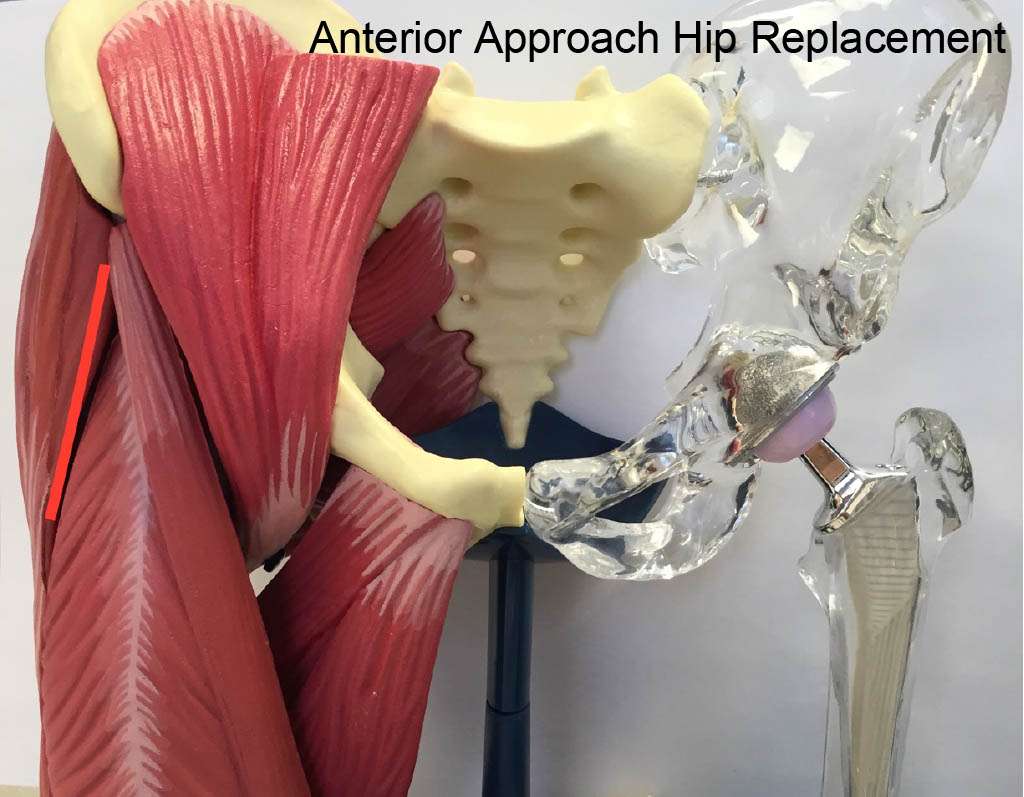
What about hip replacement? Partial hip replacements are only performed for some patients that sustain hip fractures. Surgery for arthritis is almost always best fixed with a total hip replacement. This is because partial hip replacement does not fix the socket side of the hip, which can lead to subsequent problems in younger and more active people. Total hip replacement is remarkably successful. Like knee replacement, there are multiple ways to get into a hip joint to replace it. The most common ways to do this are via an anterior approach or a posterior approach. A posterior approach uses an incision on the side or back of the hip. Anterior approach hip replacement uses an incision on the outer front of the thigh. The anterior approach has risen in popularity over the last few decades in the United States. Facts about the approaches that have consistently been shown in our orthopedic literature: anterior approach seems to have lower dislocation rates and a quicker early recovery, with longer-term results becoming more equivalent between the approaches. I perform the anterior approach because I was expertly trained to do so, and I do like the advantages of live x-ray during surgery and the outpatient success I see after surgery. Almost all hip replacement patients of mine can walk out on the day of surgery, after walking a set of stairs.
We have come so far with modern joint replacement. Almost all patients can leave the facility hours after surgery, after walking down the hall and up and down a set of stairs. We can do this due to improvements in anesthesia, pain control, and surgical technique. I hope this article helps you separate some fact from fiction with knee and hip care. Please see the resources at www.GonduskyMD.com for more information.